

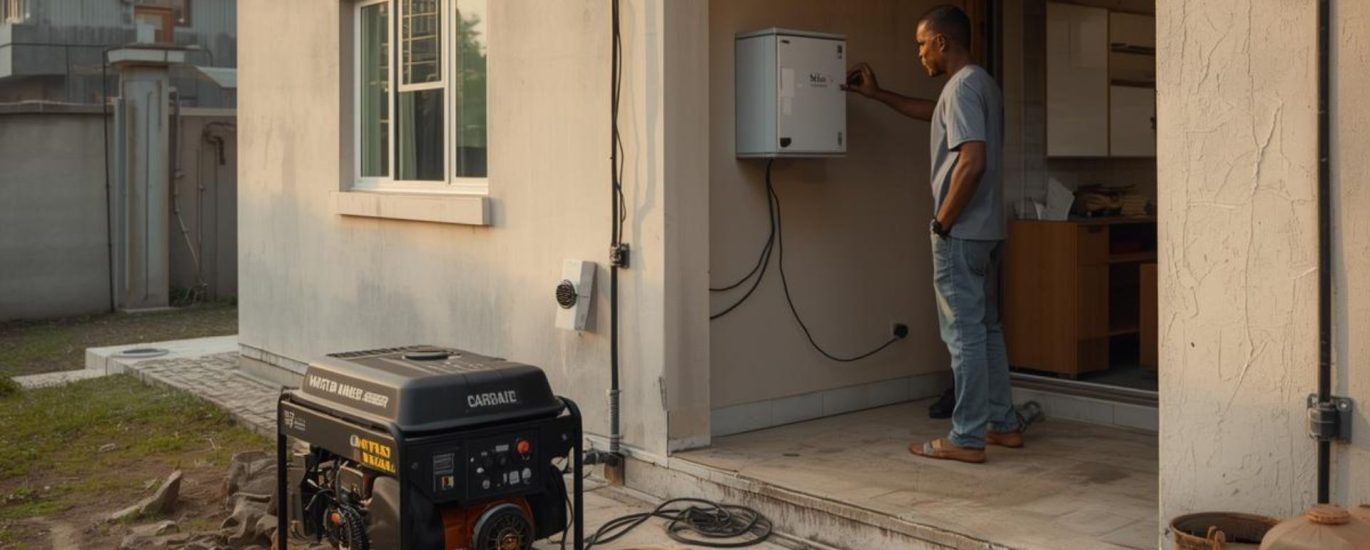
There is a sound that every Nigerian knows intimately. It is the deep, rhythmic rumble that cuts through the evening air when NEPA takes light. From Lagos to Kano, Port Harcourt to Sokoto, generators are the unofficial soundtrack of Nigerian life. We rely on them to keep our food fresh, our phones charged, our fans spinning, and our businesses running when the grid fails us.
But here is a truth that too many Nigerians learn the hard way: not every generator is right for every home. Walk through any neighbourhood and you will see the evidence. A tiny 1kVA generator screaming under the load of a refrigerator and two freezers, its engine choking on demand it was never built to handle. Or a massive 10kVA beast powering nothing but a few bulbs and a television, swallowing petrol like a thirsty elephant while its owner wonders why fuel finishes every three days.
Buying the wrong generator size is expensive. An undersized generator overheats, breaks down constantly, and damages the very appliances you bought it to protect. An oversized generator wastes fuel, costs more to maintain, and empties your pocket with every litre of petrol you pour.
This guide will help you avoid both mistakes. We will show you exactly how to calculate the generator size your Nigerian home actually needs. No confusing electrical engineering. No overseas advice that ignores our reality of multiple power outages, tropical heat, and tight budgets. Just practical maths, honest advice, and the confidence to buy right the first time.
Understanding Generator Power: kVA, kW, and Watts Explained
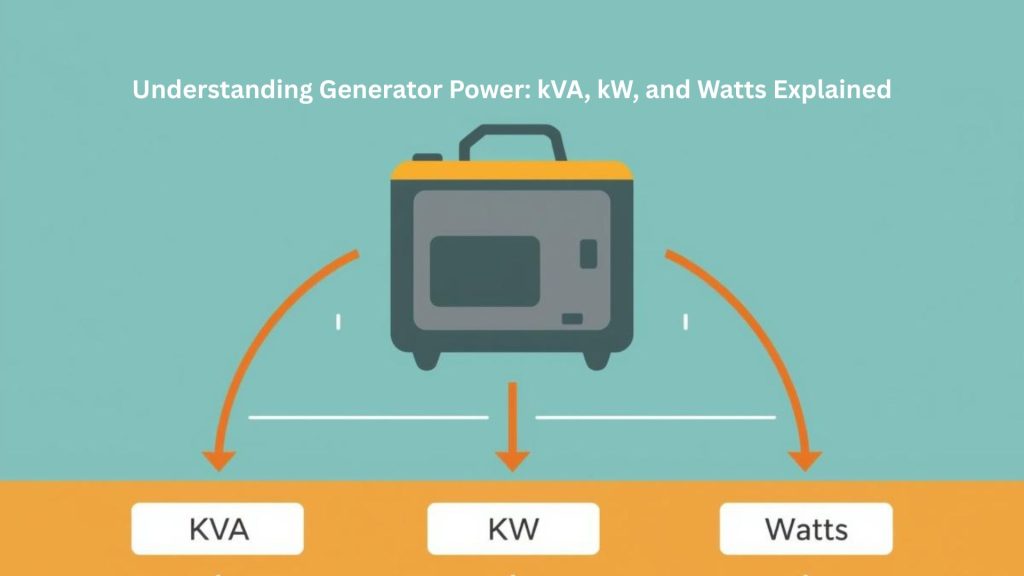
Before you can choose a generator, you need to understand what the numbers on the label actually mean. In Nigeria, generators are sold by their kVA rating. You will see 1kVA, 2.5kVA, 3.5kVA, 5kVA, 6.5kVA, 8kVA, and so on. But what does kVA actually mean?
kVA (kilo Volt-Amperes) is the total apparent power the generator can produce. It includes both the power that does useful work and the power lost as heat in the electrical system.
kW (kilo Watts) is the real power available to run your appliances. In simple terms, it is what you actually use.
To convert kVA to kW, you multiply by the power factor, which is typically 0.8 for most home generators:
kW = kVA × 0.8
So a 2.5kVA generator actually delivers about 2kW of usable power. A 5kVA generator delivers about 4kW. This distinction matters because your appliances are rated in watts, not kVA. If you do not convert properly, you will overload your generator without understanding why.
Here is a quick reference table for common Nigerian generator sizes:
Table
| Generator Size (kVA) | Usable Power (kW) | Approximate Watts |
|---|---|---|
| 1.0 kVA | 0.8 kW | 800 W |
| 1.5 kVA | 1.2 kW | 1,200 W |
| 2.5 kVA | 2.0 kW | 2,000 W |
| 3.5 kVA | 2.8 kW | 2,800 W |
| 5.0 kVA | 4.0 kW | 4,000 W |
| 6.5 kVA | 5.2 kW | 5,200 W |
| 8.0 kVA | 6.4 kW | 6,400 W |
| 10.0 kVA | 8.0 kW | 8,000 W |
Memorise this table. It is the foundation of every decision you will make about generator size.
How to Calculate Your Home’s Total Power Needs

The only way to buy the right generator is to know exactly what you will plug into it. This means making a list, checking wattages, and doing simple addition. It takes fifteen minutes and saves you years of regret.
Here is how to do it properly.
Step 1: List every appliance you want the generator to power
Be honest and thorough. Do not list everything in your house. List only what you actually need during a power outage. For most Nigerian families, this includes:
- Refrigerator or freezer
- Television and decoder
- Fans (ceiling or standing)
- Light bulbs
- Phone and laptop chargers
- Water pump (if you use one)
- Washing machine (occasional use)
- Air conditioner (if you must)
Step 2: Find the running wattage of each appliance
The running wattage is the power an appliance uses during normal operation. You can find this on a label at the back or bottom of the appliance, or in the user manual. If the label shows amps instead of watts, use this formula:
Watts = Volts × Amps
In Nigeria, our voltage is 220–240V. So an appliance rated at 2 amps uses approximately 480 watts.
Here are typical running wattages for common Nigerian home appliances:
Table
| Appliance | Typical Running Wattage |
|---|---|
| LED TV (32–43 inch) | 50–70 W |
| LED TV (50–55 inch) | 80–120 W |
| Decoder / DVD player | 20–30 W |
| Standing fan | 50–80 W |
| Ceiling fan | 60–100 W |
| Laptop charger | 60–90 W |
| Phone charger | 5–15 W |
| Energy-saving bulb (each) | 10–20 W |
| Refrigerator (inverter) | 100–150 W |
| Refrigerator (standard) | 150–250 W |
| Freezer | 150–300 W |
| Washing machine | 500–1,000 W |
| 1HP air conditioner (inverter) | 700–900 W |
| 1HP air conditioner (standard) | 1,200–1,500 W |
| 1.5HP air conditioner (inverter) | 1,000–1,300 W |
| 1.5HP air conditioner (standard) | 1,800–2,200 W |
| Water pump (small) | 500–750 W |
| Water pump (medium) | 1,000–1,500 W |
| Electric iron | 1,000–1,500 W |
| Microwave oven | 800–1,200 W |
| Blender / juicer | 300–600 W |
Step 3: Add starting surge wattage
This is the part most Nigerians miss, and it destroys generators. Appliances with motors — refrigerators, freezers, air conditioners, washing machines, and water pumps — need extra power to start up. This starting surge can be 2 to 3 times the running wattage for a few seconds.
For example, a standard refrigerator that runs on 200 watts might need 600 watts to start its compressor. A 1HP air conditioner that runs on 1,200 watts might need 2,500 watts to kick in.
To account for this, take your total running wattage and add 25 percent. This gives you a safe buffer for starting surges without overloading your generator.
Step 4: Calculate your total
Here is a realistic example for a typical Nigerian family home:
Table
| Appliance | Quantity | Running Watts Each | Total Running Watts |
|---|---|---|---|
| LED TV (43 inch) | 1 | 60 W | 60 W |
| Decoder | 1 | 25 W | 25 W |
| Standing fans | 3 | 70 W | 210 W |
| Ceiling fans | 2 | 80 W | 160 W |
| Energy-saving bulbs | 6 | 15 W | 90 W |
| Phone chargers | 4 | 10 W | 40 W |
| Laptop chargers | 2 | 75 W | 150 W |
| Inverter refrigerator | 1 | 130 W | 130 W |
| Freezer | 1 | 200 W | 200 W |
| Total Running Watts | 1,065 W |
Add 25 percent for starting surge: 1,065 × 1.25 = 1,331 W
So this family needs a generator that can comfortably deliver at least 1,331 watts of usable power. Looking at our kVA table, a 1.5kVA generator delivers about 1,200 watts — slightly too small. A 2.5kVA generator delivers 2,000 watts — perfect, with room to spare.
That room to spare matters. Running a generator at 90 to 100 percent capacity constantly wears it out fast. Aim to use only 70 to 80 percent of your generator’s rated capacity during normal operation.
Matching Generator Size to Your Nigerian Home Type
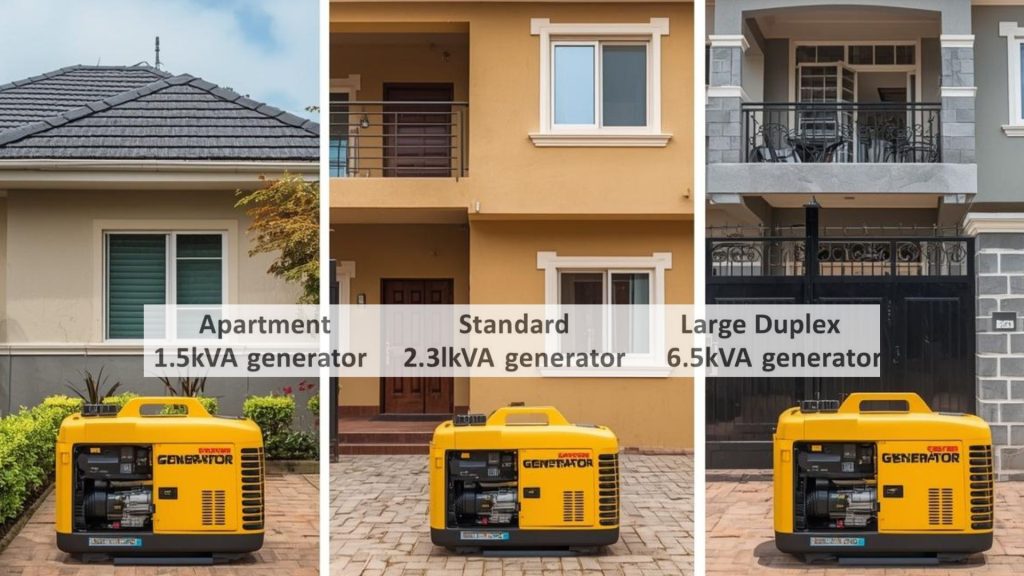
Now that you understand the maths, let us apply it to real Nigerian living situations. Your home type and family size determine your power needs more than your dreams do.
Self-Contained Room or Bachelor Pad
If you live alone in a single room, your needs are modest. You probably have a small TV, two or three bulbs, a standing fan, a phone charger, and maybe a mini fridge or small refrigerator. You do not need a generator that can power a wedding party.
Recommended generator: 1.0kVA to 1.5kVA
This size handles your basics comfortably without guzzling fuel. A 1.5kVA generator uses roughly 0.5 to 0.7 litres of petrol per hour at moderate load. Over four hours of evening use, that is 2 to 3 litres — manageable on a tight budget.
However, be realistic. A 1.5kVA generator cannot run a refrigerator, freezer, TV, fan, and iron simultaneously. If you try, the overload circuit will trip, or worse, you will burn out the engine. Prioritise what matters most during outages.
Standard Two or Three Bedroom Flat
This is the most common setup for Nigerian middle-class families. You have a refrigerator, freezer, television, multiple fans, light bulbs, phone chargers, and occasionally a washing machine or water pump. You might want to run one small air conditioner during the hottest months.
Recommended generator: 2.5kVA to 3.5kVA
A 2.5kVA generator handles the basics — fridge, TV, fans, lights — without strain. A 3.5kVA generator gives you breathing room to add a washing machine, run a small water pump, or occasionally power a 1HP inverter air conditioner.
Fuel consumption for a 3.5kVA generator at 70 percent load is roughly 1 to 1.2 litres per hour. Over six hours of evening use, budget 6 to 7 litres. That is significant, but it is the cost of keeping a family comfortable during NEPA wahala.
Duplex, Bungalow, or Large Family Compound
If you have a large sitting room, multiple bedrooms, a deep freezer, a water pump for your borehole, and you want to run one or two air conditioners, your power needs jump dramatically.
Recommended generator: 5.0kVA to 8.0kVA
A 5kVA generator handles a full household with one AC running. An 8kVA generator powers a duplex comfortably with multiple ACs, pumps, and appliances. These are serious machines with serious fuel appetites — 1.5 to 3 litres per hour depending on load.
Before buying this size, be honest about your fuel budget. A 6.5kVA generator running 8 hours daily can consume 15 to 20 litres of petrol. At current fuel prices, that is a significant monthly expense. If your budget cannot sustain it, consider a smaller generator and manage your usage carefully.
Small Business or Shop
If you run a boutique, barbing salon, cyber cafe, or small restaurant, your generator is your livelihood. You need reliability above all else.
Recommended generator: 3.5kVA to 6.5kVA depending on equipment
A barbing salon with clippers, a standing fan, and a TV needs about 2.5kVA. A cyber cafe with five computers, printers, and fans needs 3.5kVA to 5kVA. A small restaurant with freezers, blenders, and lights needs 5kVA minimum. Always size up for business use because downtime costs you customers.
Petrol vs. Diesel Generators: Which is Better for Nigeria?
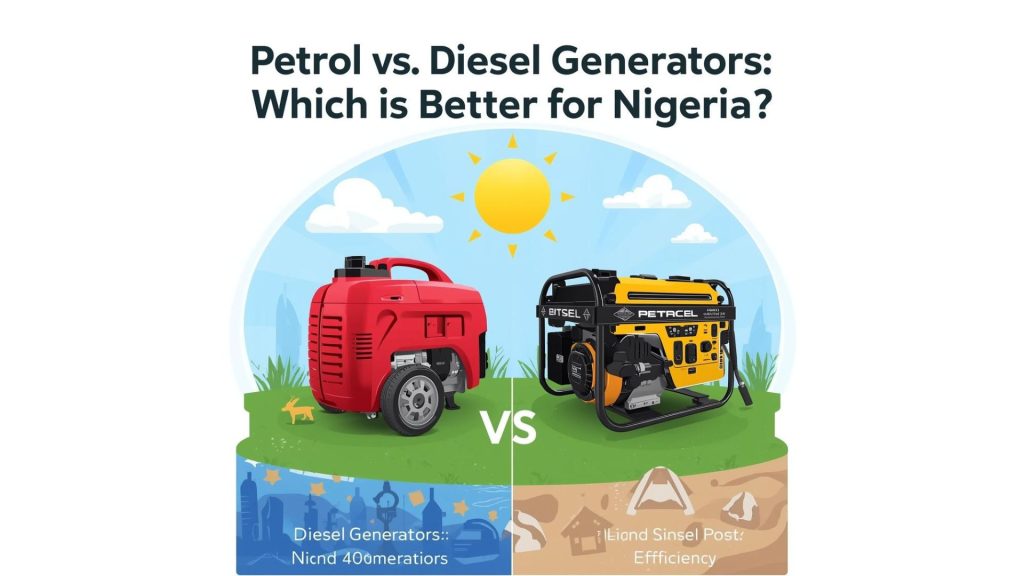
In Nigeria, petrol generators dominate the residential market. But diesel generators have their place, especially for larger homes and businesses. Understanding the trade-offs helps you choose wisely.
Petrol Generators
- Cheaper to buy — a 3.5kVA petrol generator costs 150,000 to 250,000 naira
- Easier to start — pull cord or electric start options available
- Quieter operation — better for residential neighbourhoods
- More maintenance — petrol engines need servicing every 100 to 150 hours
- Higher fuel cost per kWh — petrol is more expensive per unit of energy than diesel
- Shorter lifespan — typically 5 to 7 years with heavy use
Diesel Generators
- More expensive to buy — a 5kVA diesel generator starts around 400,000 naira
- Harder to start in cold weather — though cold is rarely a problem in Nigeria
- Louder and heavier — less suitable for small compounds
- Less maintenance — diesel engines run 500 to 1,000 hours between services
- Lower fuel cost per kWh — diesel gives more power per litre than petrol
- Longer lifespan — 10 to 15 years with proper care
For most Nigerian families in flats and small compounds, a petrol generator is the practical choice. It is affordable, portable, and easy to service. For large homes, estates, and businesses running generators daily for 8 to 12 hours, diesel becomes more economical over time despite the higher upfront cost.
One practical note: diesel is sometimes harder to source during fuel scarcity periods in Nigeria. Petrol is more widely available at every filling station and roadside vendor. If you live in a remote area, this availability factor alone might make petrol the smarter choice.
The Hidden Costs: Fuel, Maintenance, and Noise
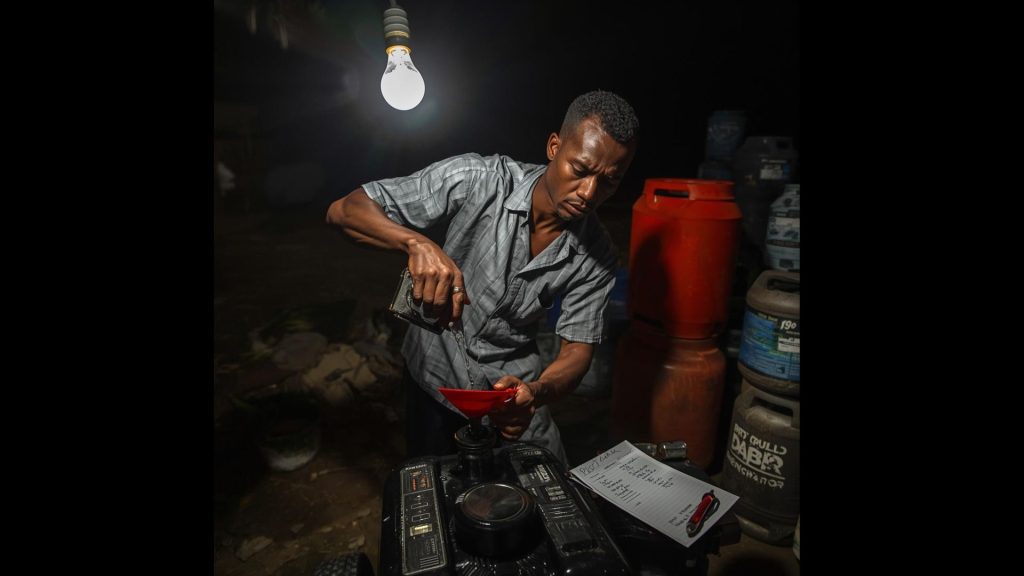
Too many Nigerians look only at the sticker price when buying a generator. They see a 2.5kVA unit for 180,000 naira and think that is the total cost. It is not. The real cost of generator ownership includes fuel, maintenance, repairs, and the social cost of noise.
Let us break this down honestly.
Fuel Costs
A 2.5kVA petrol generator running 6 hours daily consumes roughly 3 to 4 litres of petrol. At current prices, that is 4,500 to 6,000 naira per day. Over 30 days, you are spending 135,000 to 180,000 naira monthly on fuel alone. That is more than the generator itself cost you.
A 5kVA generator running the same hours consumes 6 to 8 litres daily. That is 270,000 to 360,000 naira monthly. Before you buy a larger generator, ask yourself: can my budget sustain this fuel bill every month for the next five years?
Maintenance Costs
Generators need regular oil changes, air filter cleaning, spark plug replacement, and carburettor servicing. Budget 10,000 to 20,000 naira quarterly for a small generator, and 20,000 to 40,000 naira for a large one. Skip maintenance and your generator will fail prematurely, costing you far more in repairs or replacement.
Noise and Neighbour Relations
Nigerian neighbourhoods have a social contract about generators. Start your 6.5kVA beast at 11 p.m. and your neighbours will complain. Some estates and compounds have rules about generator hours. Inverter generators are quieter but more expensive. If you live in a densely populated area, consider noise levels before buying the biggest generator your money can afford.
Environmental Costs
Generators produce carbon monoxide, a silent killer. Never run a generator indoors, in a garage, or near windows. Every year, Nigerian families lose loved ones to generator fumes. The right size generator, placed safely outdoors, is a life-or-death decision.
Trusted Generator Brands in the Nigerian Market
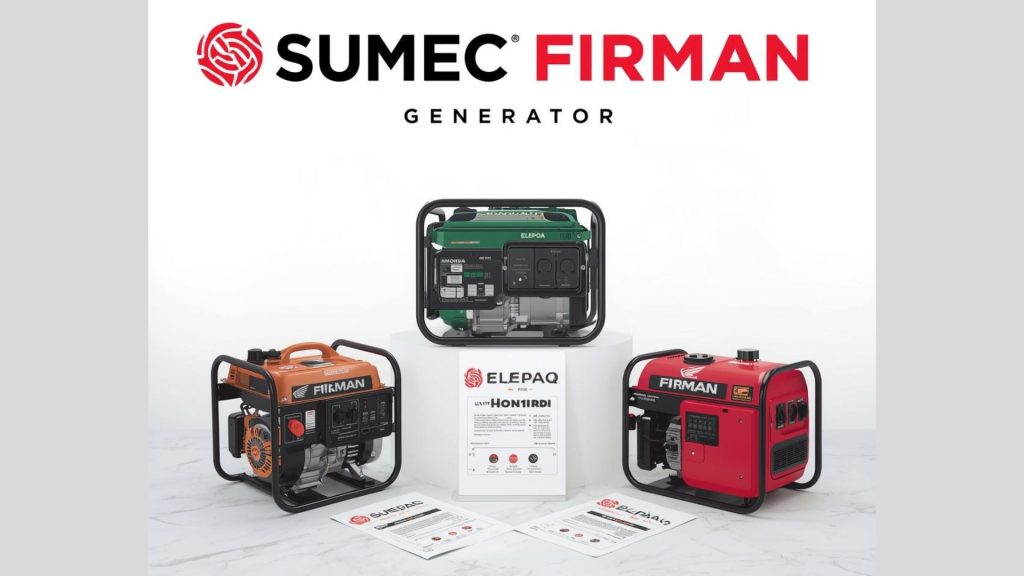
The Nigerian generator market is flooded with options, from premium Japanese brands to cheap Chinese imports with no warranty support. Here are the brands worth your money.
Sumec Firman — The undisputed king of the Nigerian generator market. Firman generators are affordable, widely available, and spare parts are everywhere. From 1kVA to 10kVA, they cover every home and business need. Build quality is decent for the price, though not exceptional.
Elepaq — A strong competitor to Firman in the same price bracket. Elepaq generators are reliable, fuel-efficient, and popular for small to medium homes. Spare parts are readily available at most generator repair shops.
Honda — Premium quality with a premium price. Honda generators are quieter, more fuel-efficient, and last longer than budget brands. A 2.5kVA Honda can cost 300,000 to 400,000 naira compared to 180,000 for a Firman equivalent. But the engine quality justifies the cost if your budget allows.
Lutian — A mid-range Chinese brand that offers good value. Lutian generators are more affordable than Honda but better built than the cheapest options. Spare parts are increasingly available.
Thermocool (Haier) — Known for home appliances, Thermocool also produces generators with decent performance. Their service network is solid in major cities.
Avoid brands you have never heard of, sold by roadside vendors with no warranty card and no physical address. When your generator breaks down — and it will — you need spare parts and a technician who knows the engine. Obscure brands leave you stranded.
Common Mistakes Nigerians Make When Buying Generators
Learn from the errors others have already paid for.
Mistake 1: Buying based on price alone
That 1.5kVA generator going for 80,000 naira is cheap for a reason. It likely has a weak engine, fake copper windings, and no warranty. Within six months, the cost of repairs exceeds the purchase price.
Mistake 2: Ignoring the starting surge
You calculated your running watts perfectly but forgot that your refrigerator needs triple power to start. Now your generator trips every time the fridge compressor kicks in. Always add that 25 percent buffer.
Mistake 3: Overloading the generator
You bought a 2.5kVA generator and you are trying to run two freezers, a TV, four fans, and a washing machine simultaneously. The generator overheats, the engine smokes, and you blame the brand. Respect your generator’s limits.
Mistake 4: Poor placement and ventilation
Generators need airflow to cool down. Placing yours in a tight corner, under a staircase, or inside a partially enclosed shed traps heat and damages the engine. Give it space to breathe.
Mistake 5: Using bad fuel or dirty oil
Buying petrol from roadside vendors who mix it with kerosene destroys your carburettor. Using the same engine oil for a year without changing it grinds the engine to dust. Use clean fuel from reputable stations and change your oil every 100 hours of operation.
Mistake 6: No voltage regulation
Voltage fluctuations from generators can damage your TV, fridge, and phone chargers. Use a stabilizer for sensitive electronics, or buy a generator with built-in AVR (Automatic Voltage Regulation).
Our Generator Recommendations by Home Size and Budget
Table
| Home Type | Appliances to Power | Recommended Size | Estimated Fuel Cost/Month |
|---|---|---|---|
| Self-contained room | TV, fan, bulbs, phone chargers, mini fridge | 1.0–1.5 kVA | ₦40,000–₦70,000 |
| 2-bedroom flat | Fridge, TV, fans, lights, freezer | 2.5–3.5 kVA | ₦135,000–₦180,000 |
| 3-bedroom flat | Fridge, freezer, TV, fans, pump, 1 small AC | 3.5–5.0 kVA | ₦180,000–₦270,000 |
| Duplex / large home | Multiple ACs, pumps, full household | 5.0–8.0 kVA | ₦270,000–₦450,000 |
| Small business | Computers, lights, fans, equipment | 3.5–5.0 kVA | ₦180,000–₦270,000 |
| Restaurant / heavy use | Freezers, blenders, lights, AC | 6.5–10.0 kVA | ₦350,000–₦600,000 |
These fuel estimates assume 6 hours of daily generator use at current petrol prices. Adjust based on your actual usage and local fuel costs.
When to Consider Solar and Inverter Instead
[IMAGE PLACEMENT 9: Alternative Energy]Image Prompt: A Nigerian home rooftop with solar panels installed, with an inverter and battery unit visible on a wall beside the house. A small generator sits unused in the corner. Bright sunny day, clean and modern look, aspirational photography showing energy independence.
Image Size:1200 x 800 pixels (3:2 ratio) — compress to under 150KB
Alt Text:Solar panels and inverter system on Nigerian home rooftop with unused generator
Title:Solar and Inverter as Alternative to Generators in Nigeria
Caption:
For homes with consistent daytime power needs, solar plus inverter can reduce generator use by 70 percent or more.
Generators are not the only solution to Nigeria’s power problems. For many homes, a hybrid approach combining solar panels, inverter batteries, and a small backup generator is more cost-effective long-term.
Solar panels generate free electricity during the day when the sun is strongest. An inverter battery stores excess power for evening use. A small generator handles only the heaviest loads or extended cloudy periods. This setup can reduce your monthly fuel bill by 50 to 80 percent.
The upfront cost is significant — a basic solar-inverter system for a 2-bedroom flat starts around 500,000 to 800,000 naira. But over three to five years, the savings on fuel often recover that investment. And unlike generators, solar panels have no moving parts and require almost no maintenance.
If you are buying a generator today, consider whether your budget could stretch to include at least a small inverter system. Even a 1kVA inverter with two batteries can power your lights, fans, and TV for 4 to 6 hours without touching a litre of petrol.
Pay Small Small: Get the Right Generator Without Breaking the Bank

A quality generator is one of the most important investments you will make for your Nigerian home. It protects your food, powers your business, keeps your family comfortable, and gives you peace of mind when NEPA fails. But the right generator is not cheap, and paying outright is not always possible.
That is where pay small small changes everything.
Instead of settling for an undersized generator because it is all you can afford today, you can choose the correct size for your actual needs and spread the cost over time. A 3.5kVA generator that properly powers your home becomes accessible. A 5kVA unit that handles your AC and water pump is no longer out of reach.
Our pay small small plan lets you choose daily, weekly, or monthly payments that match your income flow. No hidden charges. No surprises. Just reliable power made affordable.
We stock genuine Sumec Firman, Elepaq, Honda, and Lutian generators with full manufacturer warranties. We deliver to every state in Nigeria. And our team can help you calculate exactly what size you need before you buy.
Do not guess. Do not settle. Do not buy a generator that will fail you when the heat is at its worst. Get the right size, the right brand, and the right payment plan.
Final Thoughts: Power is Peace of Mind
In Nigeria, a generator is not a luxury. It is infrastructure. It is the difference between a restless night in the heat and a peaceful sleep under a spinning fan. It is the difference between watching the Champions League final and listening to your neighbour’s generator while your TV stays dark.
But the wrong generator brings more problems than it solves. It wastes fuel. It breaks down. It damages your appliances. It annoys your neighbours. And it empties your wallet without giving you the comfort you paid for.
The right generator, sized correctly for your home, gives you power without pain. It runs efficiently. It lasts for years. It starts when you need it and stops when you do not. And with proper maintenance, it becomes a faithful companion through every NEPA outage to come.
Measure your appliances. Do the maths. Choose a trusted brand. And buy the generator your home actually needs.
Ready to end the darkness for good?
Browse our collection of Sumec Firman, Elepaq, Honda, and Lutian generators — all sizes, all trusted brands. Use our generator calculator to find your perfect match. Pay small small with daily, weekly, or monthly plans. We deliver to all 36 states in Nigeria.
